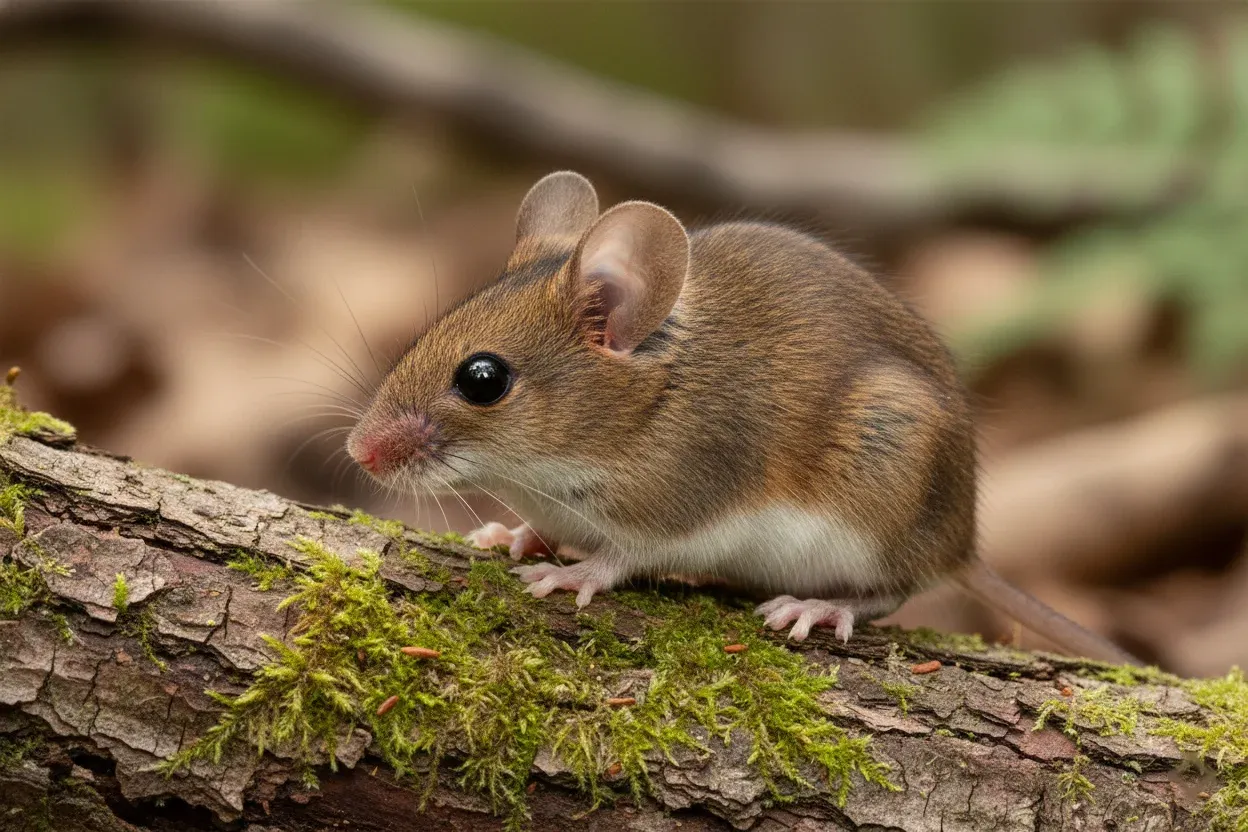
The Deer Mouse
SPECIES PROFILE — EXTREME BIOHAZARD
Class: Rodents
Species profile for the deer mouse, including hantavirus risk, eradication protocol, and permanent prevention guidance.
The Deer Mouse
The deer mouse is not just another house mouse. It is a biological hazard species and the primary rodent reservoir associated with Hantavirus Pulmonary Syndrome in North America.
Overview
In practical home control terms, the deer mouse changes the entire risk model. You are no longer just solving a nuisance problem. You are dealing with droppings, urine, and nesting debris that can become dangerous when disturbed.
Visual ID: Is This a Deer Mouse?
You can usually distinguish a deer mouse from a standard house mouse by three features:
- Two-tone coat: dark upper body with a sharply lighter underside.
- Bicolored tail: darker above, lighter below.
- Large eyes and ears: more prominent than the common house mouse.
The Threat: Hantavirus
The critical issue is aerosolized contamination. The danger does not come from being bitten in most home scenarios. It comes from disturbing dried droppings, urine, and nesting material, then inhaling contaminated particles.
What Makes It Dangerous
- Deer mice can contaminate enclosed spaces for long periods.
- Vacuums and dry sweeping can aerosolize virus-bearing particles.
- Attics, sheds, garages, and seasonal cabins are common exposure zones.
Eradication Protocol
The mechanical control side is straightforward:
- Use standard snap traps placed tightly along walls and edges.
- Deploy enough traps to overwhelm the problem.
- Avoid casual under-deployment.
- Inspect elevated storage zones, attic perimeters, and low-traffic corners.
What To Avoid
- Live-catch traps: increase handling risk.
- Glue boards: increase stress, contamination, and cleanup complexity.
- Loose poison-first thinking: introduces extra uncertainty and carcass location problems.
Hazmat & Cleanup Protocol
Cleanup matters as much as trapping:
- Ventilate the area before entering.
- Wear gloves and an appropriate mask or respirator.
- Saturate droppings and nesting material with disinfectant before removal.
- Never dry sweep or vacuum contaminated debris first.
- Bag waste immediately and sanitize surrounding surfaces.
Exclusion (Permanent Prevention)
Deer mice exploit the same structural weaknesses as other small rodents:
- unsealed utility penetrations
- attic gaps
- soffit transitions
- foundation cracks
- garage door edge failures
Recommended materials:
- copper mesh
- steel wool paired with sealant
- high-quality exterior sealant
- hardware cloth where gnaw pressure is expected
Permanent Prevention
A successful deer mouse response has three layers:
- rapid identification
- aggressive mechanical elimination
- structural exclusion with safe cleanup
Conclusion
The deer mouse should be treated as a high-risk target, not a standard pest. Speed matters, but procedure matters more. If identification, trapping, cleanup, and exclusion are done correctly, you reduce both infestation pressure and biological exposure risk.
Explore the Pest.gg Wiki